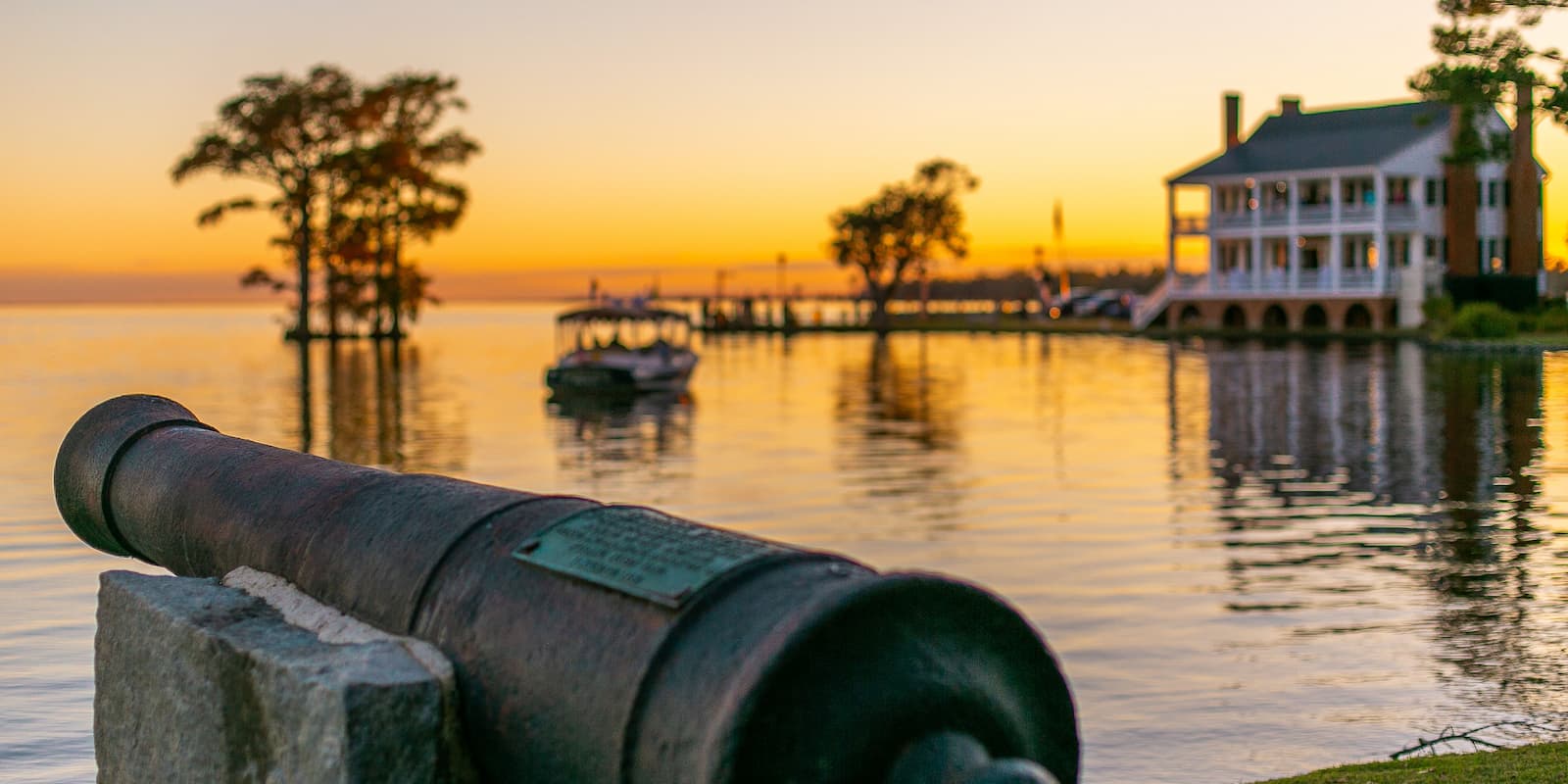
What makes a small North Carolina town beautiful enough to earn national recognition? In Edenton, the answer is right in front of you. Walk down Broad Street, and you’ll find centuries-old homes, beautiful gardens, and architectural details that have survived generations. Turn toward the waterfront, and you’re looking out over Edenton Bay, with one of North Carolina’s most recognizable historic lighthouses nearby.
In 2011, Forbes named Edenton one of America’s prettiest towns. The publication also recognized Edenton’s existing nickname, “The South’s Prettiest Small Town.” It wasn’t a newly awarded title, but the national attention helped introduce more travelers to a town already celebrated for its historic architecture and waterfront setting.
But what makes Edenton stand out among the small towns in North Carolina? It’s more than a collection of beautiful buildings. It’s the way those buildings, the waterfront, and everyday life fit together.
Here at our North Carolina bed and breakfast, that’s what we love sharing with guests. Edenton has an extraordinary amount of history, but it doesn’t feel like a museum. People still live and work in these historic neighborhoods, care for their gardens, and take pride in preserving what makes the town special.
A Beautiful Town with More Than 300 Years of History
Edenton’s story goes back well before its national recognition. Incorporated in 1722, it served as North Carolina’s first colonial capital and became an important political and commercial center. Today, its historic district contains architecture representing approximately 250 years of the town’s development.
What makes this history especially interesting is how much of it visitors can still see. Along Broad Street and the surrounding neighborhoods, you’ll find historic homes with welcoming porches, decorative trim, carefully maintained gardens, and architectural features that reflect different periods of the town’s past. Some buildings are important historic landmarks. Others are private homes that remain part of everyday life.
Edenton’s beauty isn’t limited to a few restored attractions. Much of it comes from the historic character of the town itself and the care that generations of residents have taken to preserve it.
And while Edenton’s colonial architecture draws plenty of attention, its history is more complicated than its beautiful buildings might suggest. The town’s early prosperity was connected to trade and slavery, and its waterfront later played a role in the Maritime Underground Railroad. Understanding those stories adds meaning to the places visitors see today.
Discover Edenton’s Historic Beauty on the Trolley Tour
One of the best ways to appreciate Edenton, especially on your first visit, is to take the Historic Edenton Trolley Tour.
This 50-minute narrated tour introduces visitors to more than 300 years of local history. Rather than trying to identify every historic building on your own, you’ll hear the stories behind Edenton’s neighborhoods, architecture, and the people who helped shape the town.
It’s a wonderful introduction to places like the Penelope Barker House, associated with the famous 1774 Edenton Tea Party, and the Cupola House, built around 1758 and known for its distinctive architecture and gardens.
The 1767 Chowan County Courthouse is another important part of Edenton’s architectural heritage. One of the country’s most significant surviving colonial courthouses, it remains an important landmark in the historic district.
And then there’s the 1886 Roanoke River Lighthouse, standing along the waterfront as a reminder of Edenton’s maritime history.
These landmarks are impressive individually, but seeing them in the context of the surrounding neighborhoods helps explain why Edenton has earned such a reputation for beauty.
The trolley departs from the Penelope Barker House Welcome Center on South Broad Street. It’s a narrated ride rather than a hop-on, hop-off service, so plan to remain aboard for the entire tour. Schedules can change, and we recommend confirming availability before your visit.
Afterward, you can return to the places that caught your attention and explore them more closely on foot.
Don’t Miss the Details Between the Landmarks
The famous landmarks deserve attention, but some of Edenton’s most interesting sights are easy to overlook.
One is the Lane House (304 E. Queen St.) which dates to 1718–1719 and is recognized as North Carolina’s oldest dated house. It’s a remarkable reminder of how far back Edenton’s architectural history reaches.
Another is St. Paul’s Episcopal Church (101 W Gale St.), whose 18th-century building is an important part of the town’s historic character.
We also encourage visitors to pay attention to the gardens, fences, porches, and architectural details along Broad Street and King Street.
You don’t have to know the name or history of every house to appreciate what you’re seeing. Sometimes it’s the combination of an old doorway, a beautiful garden, and the neighboring homes that makes a particular stretch of street worth remembering.
Just remember to please enjoy private homes and gardens from public sidewalks unless a property is specifically open for tours.
The Waterfront Is Part of What Makes Edenton Different
Edenton’s historic streets would be beautiful on their own. What gives the town another dimension is its location on Edenton Bay, connected to the Albemarle Sound.
The waterfront has been important to Edenton for centuries. In the colonial period, the town developed as a port and trading center. Today, visitors can enjoy the view from the waterfront park and see how closely the town’s history is tied to the water.
Colonial Park is a good place to spend time after exploring downtown. You can enjoy the open views of the bay, see the lighthouse, and appreciate how close the historic streets are to the shoreline.
For visitors comparing the best towns in North Carolina for a weekend getaway, this combination is worth considering. You don’t have to choose between historic sightseeing and waterfront scenery. In Edenton, both are part of the same visit.
Is Edenton Worth Visiting for a Weekend?
We certainly think so, especially if you enjoy history, architecture, gardens, and exploring a town on foot.
You can see several of Edenton’s best-known landmarks in a single day. But a weekend gives you more flexibility to take a guided historic tour, explore the surrounding streets, visit downtown shops, and enjoy a meal without trying to fit everything into a few hours.
If you’re planning your first visit, start with the landmarks above and leave some time to explore the surrounding historic district. A guided tour is especially worthwhile if you’d like to understand the people and events behind the buildings.
Edenton also works well for travelers who appreciate destinations where the town itself is the main attraction, rather than a long schedule of activities.
Inner Banks Inn: Historic Buildings With Stories of Their Own
At Inner Banks Inn, Edenton’s history is part of the guest experience. Our property includes historic buildings that have served very different purposes over the years, and each has its own connection to the town’s past.
The Satterfield House, built in 1801, is the oldest original house along Broad Street. It represents the residential architecture that gives Edenton’s historic neighborhoods so much of their character.
The Lords Proprietors’ House, also associated with the White-Bond House name, is a 20th-century Victorian mansion. Its wraparound porch overlooking Broad Street is a familiar feature of the inn and reflects a later chapter in Edenton’s architectural history.
The Pack House tells a different story. Built in 1915 as a tobacco barn, it was moved to the property from Strawberry Hill Plantation and converted into guest accommodations.
Perhaps one of the most interesting stories belongs to the Tillie Bond Cottage. Built in the late 1800s, it was once the home of Tillie Bond, the last private resident of Edenton’s Cupola House. When the historic Cupola House was at risk of losing more of its original architectural features, local residents helped provide Tillie with another home.
Even our guest room names tell stories. Names such as the Granville Suite, Chowan Room, and Arrowhead Room recognize people, places, and Indigenous history connected to northeastern North Carolina.
For us, these buildings are more than accommodations. They’re part of the same preservation story visitors discover throughout Edenton.
Come Experience Edenton’s History for Yourself
Edenton’s reputation for beauty has been built over generations, through the preservation of its buildings, neighborhoods, and local stories.
At Inner Banks Inn, we’re proud to be part of that history and to share it with the guests who come to discover our town.
We invite you to plan your Edenton getaway and see why this small North Carolina town continues to make such a lasting impression.